Soft tissue sarcoma
radiation therapy for
pets in Florida.
Soft tissue sarcomas extend far beyond their visible borders. Surgery alone leaves microscopic disease behind in most cases — and local recurrence is the rule, not the exception. Adjuvant radiation after incomplete excision reduces recurrence by more than 70% and is the standard of care for STS in dogs and cats.
The tumor looks contained.
It never is.
Soft tissue sarcomas are a group of malignant tumors arising from connective tissue — fat, muscle, fascia, nerves, and blood vessels. In dogs and cats, STS most commonly appears as a firm subcutaneous or deep mass on the trunk, limbs, or head and neck. Their defining characteristic: microscopic tumor cells extend 2–3 centimeters beyond the palpable tumor margin in virtually every case.
This biological behavior makes complete surgical excision technically demanding even for experienced surgeons — and at anatomically constrained sites like the distal limb, digits, face, or perineum, truly wide margins are often impossible. A soft tissue sarcoma that appears to have been fully removed almost always leaves microscopic residual disease in the surgical bed. Without adjuvant treatment, local recurrence is expected in the majority of cases within 6–12 months.
Why adjuvant radiation changes outcomes
Post-surgical radiation targets the entire surgical bed — including the at-risk tissue surrounding it — delivering dose precisely to the zone where microscopic STS cells remain after excision. Multiple veterinary oncology studies document a reduction in local recurrence of more than 70% when adjuvant radiation follows incomplete STS excision, compared to surgery alone. The combination of surgery and radiation also consistently produces longer disease-free intervals than re-excision without radiation.
Grade matters — but incomplete margins matter more
High-grade STS (grade II–III) carries elevated recurrence risk even with apparently clean margins, and adjuvant radiation is recommended regardless of reported margin width. For grade I STS with truly wide, clean margins, the benefit of radiation is more nuanced — Dr. DiBernardi reviews each case individually to determine whether the expected recurrence risk justifies a full radiation course. There is no universal answer: the decision is made with the full clinical picture in hand.
STS in dogs and cats —
by tumor type.
Soft tissue sarcoma is not a single disease — it's a family of tumors with distinct biology, behavior, and radiation response. Dr. DiBernardi reviews histology and grade for every case before recommending a protocol.
Pathology in hand.
Plan built around it.
Every STS radiation plan at AARADONC starts with a full review of the pathology report, grade, margin status, mitotic index, and imaging. Dr. DiBernardi determines the optimal protocol for each dog or cat individually — adjuvant CFRT is the standard for most cases.
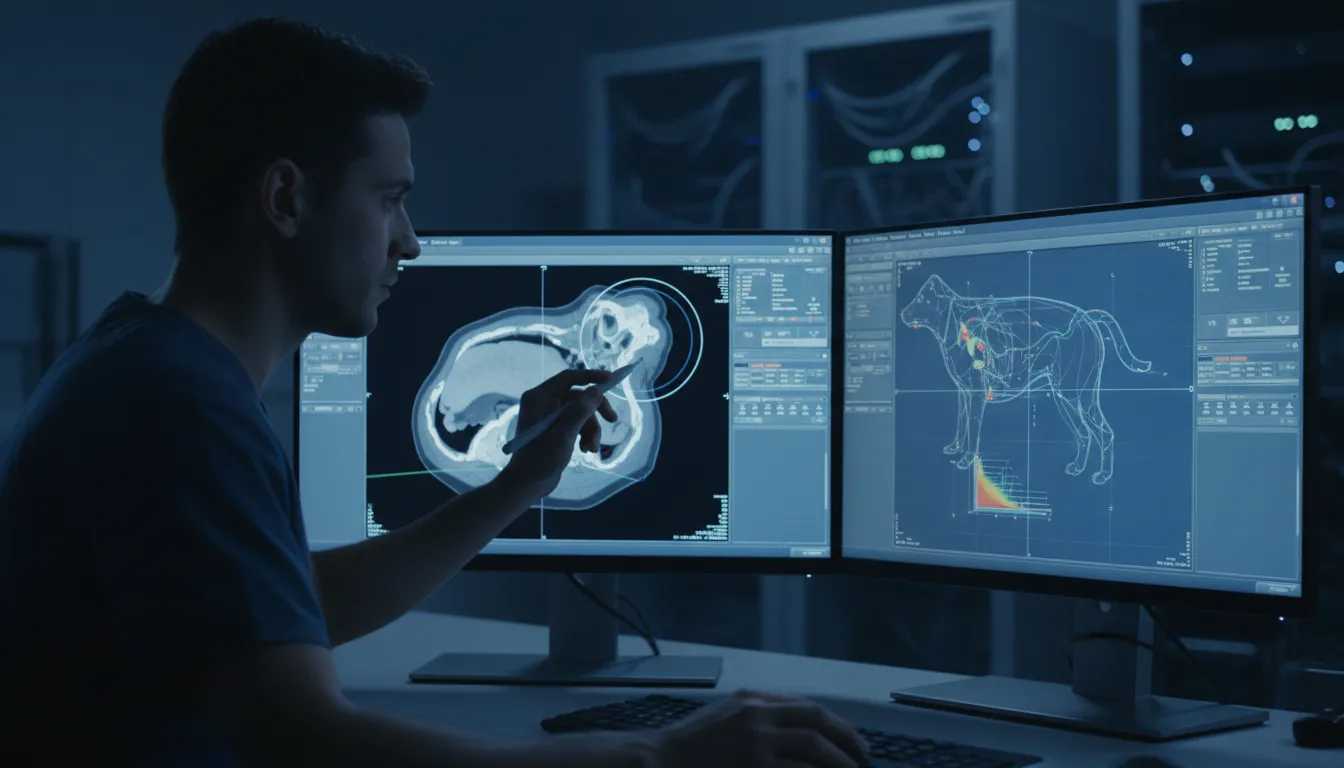
Surgical margin status and tumor grade on histopathology are the foundation of every STS radiation plan at AARADONC.
The standard adjuvant protocol for incomplete STS excision in dogs and cats. Targets the full surgical bed and at-risk margins to eliminate microscopic residual disease. 16–20 outpatient sessions over 3–4 weeks.
For soft tissue sarcomas that cannot be surgically removed, or recurrent STS where re-excision is not an option. Achieves local tumor control and reduces mass effect with fewer sessions.
Soft tissue sarcoma radiation —
what pet owners ask us most.
Don't wait.
Post-surgical radiation for soft tissue sarcoma is most effective within 4–6 weeks of surgery. Whether you've been referred by your veterinarian or are reaching out directly, request a consultation and Dr. DiBernardi will review the pathology personally.
Request a Consultation →pre- or post-surgical.
Send pathology, surgical notes, and imaging. We prioritize post-surgical STS cases and acknowledge all referrals the same day. Pre-surgical consultation available when RT planning benefits from coordinating with the surgical approach.
Submit a Referral →