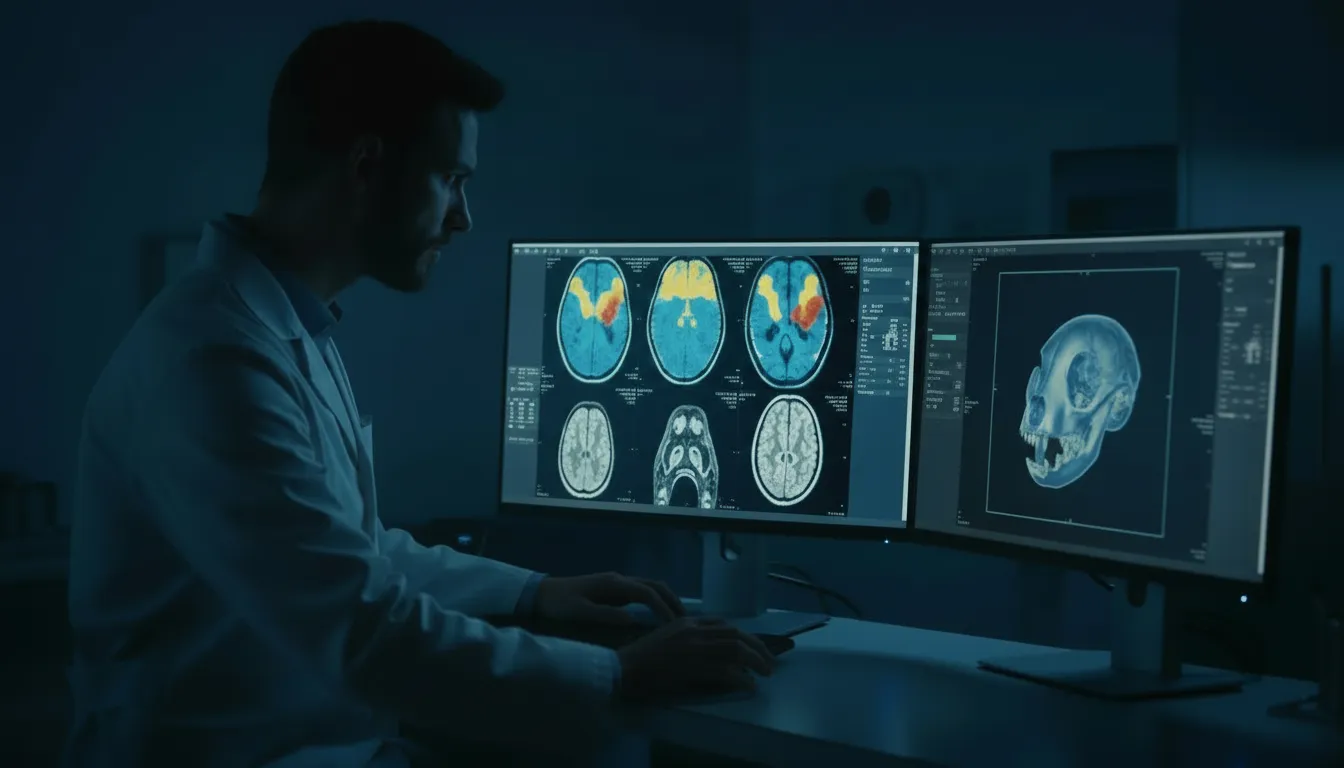
Spinal tumor radiation
therapy for pets
in Florida.
Spinal tumors cause progressive neurological compromise — weakness, paralysis, and pain. Radiation therapy can relieve spinal cord compression, halt progression, and restore function when surgery is not possible or incomplete.
“The only center 100% dedicated to Radiation Oncology in Florida”
When the spine is the problem,
precision matters most.
Spinal tumors compress or invade the spinal cord — producing progressive weakness, incoordination, and pain that worsens as the tumor grows. The spinal cord's sensitivity to radiation requires submillimeter targeting accuracy. At AARADONC, this is exactly what our technology provides.
Spinal tumors in dogs and cats are classified by where they arise relative to the spinal cord: extradural (outside the dural sac — most often vertebral tumors or metastatic disease), intradural-extramedullary (within the dural sac but outside the cord — includes meningiomas and nerve sheath tumors), and intramedullary (within the cord itself). Each type has different surgical accessibility and radiation responsiveness.
Why radiation therapy is often the primary option
Many spinal tumors — particularly intramedullary masses and tumors at surgically challenging vertebral levels — cannot be safely removed without risk of permanent neurological damage. Radiation therapy targets these tumors with precision that surgery cannot match in these locations, delivering therapeutic doses to the tumor while respecting the adjacent spinal cord's tolerance limits.
SRS/SRT — precision for the spine
Stereotactic radiation (SRS/SRT) is ideally suited for spinal tumors. It delivers ablative doses in 1–5 sessions with submillimeter accuracy, protecting the delicate spinal cord while maximizing tumor dose. For well-defined spinal tumors, SRS/SRT can achieve durable local control with minimal sessions and rapid treatment completion.
Submillimeter precision
where it matters most.
Spinal tumor treatment at AARADONC starts with a complete specialist review — MRI and CT imaging, neurological status, treatment history. Dr. DiBernardi personally designs every plan, selecting between SRS/SRT and CFRT based on tumor type, location, and urgency.
Varian TrueBeam® + IGRT. Cone Beam CT imaging before every session is especially critical for spinal tumors — the spinal cord's radiation tolerance demands submillimeter positioning accuracy at every fraction.
SRS/SRT for well-defined tumors. 1–5 sessions with submillimeter accuracy using VMAT/RapidArc — maximum precision at the spinal cord, where tolerances are strictest.
CFRT for post-surgical or diffuse disease. When the surgical bed requires treatment or the tumor is less well-defined, CFRT with daily IGRT provides the dose distribution and accuracy needed.
SRS/SRT or CFRT — chosen by tumor type and location.
What pet owners
ask us most.
Same-day response.
Dr. DiBernardi personally reviews every case. Tell us about your pet and we'll respond the same day with a clear, honest recommendation.
Request a Consultationa spinal tumor.
Submit a referral and receive same-day acknowledgment. We coordinate directly with your practice throughout treatment and provide full written reports.
Referral Information →